
ASCII & Binary: Under the Hood of How Computers Read Text
How does a sequence of 0s and 1s translate to human readable text? Learn the math behind binary notation, character encodings like ASCII and Unicode, and how to convert bytes manually.
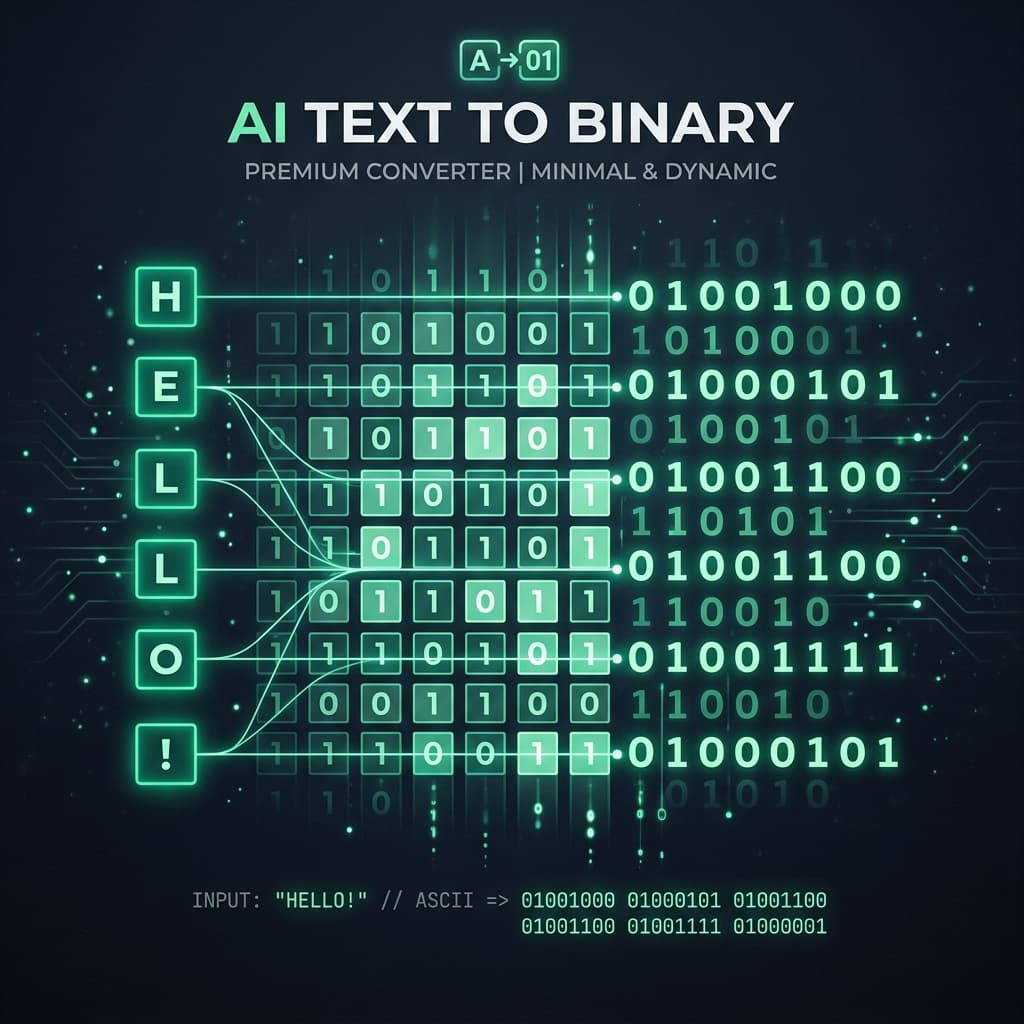
How Computers Represent Text: Bytes, Bits & Bases
At the lowest level, computers cannot understand characters, words, or images. Silicon microchips are built using billions of tiny transistors that act as simple electrical switches. These switches can either be OFF (0) or ON (1).
These binary states are called bits (binary digits). To represent complex data like human language, computers group bits into clusters. A standard group of 8 bits is called a byte. Because each bit has 2 options, an 8-bit byte can represent 28 = 256 unique variations.
What is character encoding?
To make a byte represent a letter, character encodings establish standard dictionary lookup maps. The oldest and most famous standard is ASCII (American Standard Code for Information Interchange), designed in 1963.
ASCII maps the integers from 0 to 127 to specific symbols:
- Decimal 65 represents the uppercase letter A.
- Decimal 97 represents the lowercase letter a.
- Decimal 32 represents a Space character.
- Decimal 48 represents the digit symbol 0.
For international languages, modern systems use Unicode (UTF-8), which extends ASCII to support emojis and non-Latin characters using multiple bytes.
Step-by-Step: How to Convert Binary back to Text
Let's decode a byte step-by-step: 01001000.
- Position Values: Each digit from right to left represents ascending powers of 2, starting at 20 (1):
[128] [64] [32] [16] [8] [4] [2] [1] - Multiply: Match our byte digits:
0 × 128 = 01 × 64 = 640 × 32 = 00 × 16 = 01 × 8 = 80 × 4 = 00 × 2 = 00 × 1 = 0 - Sum:
64 + 8 = 72. - ASCII Dictionary Lookup: Decimal value 72 maps to the uppercase letter H.
Multi-Base representations: Hexadecimal and Octal
Because binary sequences are extremely long and difficult for humans to read, developers use other base representations:
| Base system | Radix | Purpose | Sample |
|---|---|---|---|
| Binary | Base 2 | Hardware switches representation | 01000001 |
| Octal | Base 8 | Group bytes into 3-bit sections (rare now) | 101 |
| Decimal | Base 10 | Standard human mathematical counting | 65 |
| Hexadecimal | Base 16 | Compact byte grouping (2 hex digits = 1 byte) | 41 |
Decode and Encode Instantly
Tired of performing binary binary math by hand? Use our free Binary to Text Translator. It converts text to binary, hexadecimal, octal, and decimal simultaneously, and lets you decode bytes back to plain English with instant syntax validation. It also includes an interactive, searchable ASCII code chart!