
CAGR vs IRR: How to Calculate True Multi-Year Investment Returns in 2026
Measuring investment returns correctly is vital. Understand the difference between CAGR (single growth rate) and IRR (variable cash flows), including compounding calculations and inflation discounts.

CAGR vs IRR: How to Calculate True Multi-Year Investment Returns
Measuring investment performance accurately is crucial for developers, startup founders, and personal finance planners. When comparing multi-year assets, simple absolute returns are misleading because they ignore the time value of money. To evaluate compounding gains, the industry relies on two core metrics: Compound Annual Growth Rate (CAGR) and Internal Rate of Return (IRR).
CAGR: The geometric growth rate
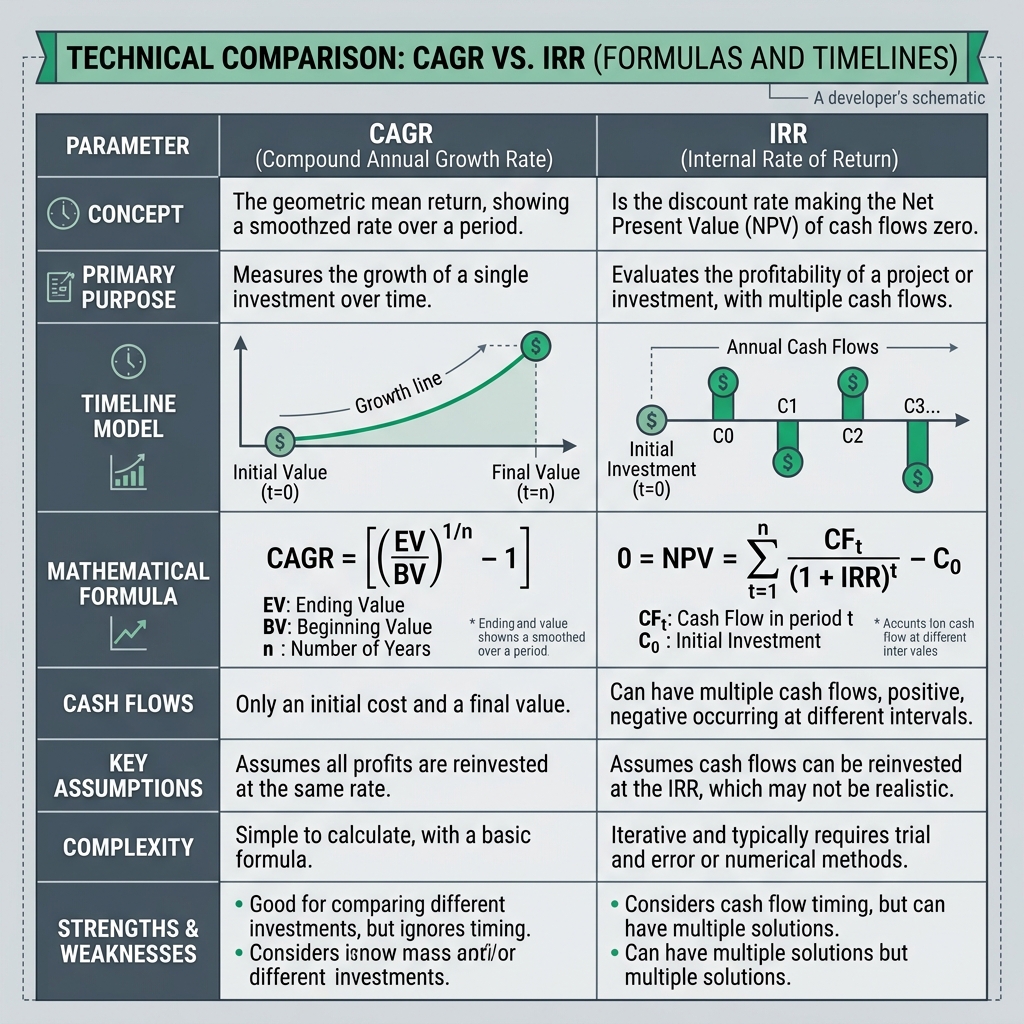
CAGR represents the annualized rate of return required for an investment to grow from its initial balance to its final balance, assuming the profits are reinvested at the end of each year. It describes a smoothed growth rate, stripping out year-to-year volatility.
The mathematical formula for CAGR is straightforward:
CAGR = (V_final / V_initial)^(1 / n) - 1
Where V_final is the ending value, V_initial is the starting value, and n is the duration in years. CAGR is the ideal metric for "buy-and-hold" scenarios where you make a single initial investment and withdraw the money years later (such as fixed deposits or lump-sum mutual funds) with no intermediate transactions.
IRR: Accounting for variable cash flows
CAGR fails when you add or withdraw money during the investment lifecycle—such as monthly SIP (Systematic Investment Plan) contributions or venture capital distributions. In these scenarios, you must use IRR.
IRR calculates the discount rate at which the Net Present Value (NPV) of all cash flows (both positive inflows and negative outflows) equals zero. It is computed by solving the following equation for r:
NPV = Sum [ CF_t / (1 + r)^t ] = 0
Where CF_t is the cash flow at time t, and r is the internal rate of return. Because this equation cannot be solved algebraically, financial calculators and spreadsheets solve it iteratively through numerical approximation methods (such as Newton-Raphson).
Which metric should you use?
Choosing between CAGR and IRR depends entirely on your investment pattern:
- Use CAGR: For single, lump-sum investments with a clear start and end point (e.g., assessing stock returns over a five-year hold).
- Use IRR: For multiple deposits, capital calls, dividends, or irregular withdrawals (e.g., SIP portfolios, real estate flips, or corporate project valuations).
Conclusion
Both metrics are essential tools in a developer's financial toolkit. By computing CAGR for point-to-point holdings and IRR for dynamic cash flows, you can make objective, math-backed investment decisions and protect your assets from inflation decay.
Try it free