
Claude 4.8 Opus: The Next Frontier of Cognitive Coding and Multi-Step Reasoners
An in-depth analysis of Anthropic's new Opus 4.8 model. Discover its benchmarks, local Wasm sandboxing capabilities, agentic planning loops, and how it compares to OpenAI's latest releases.
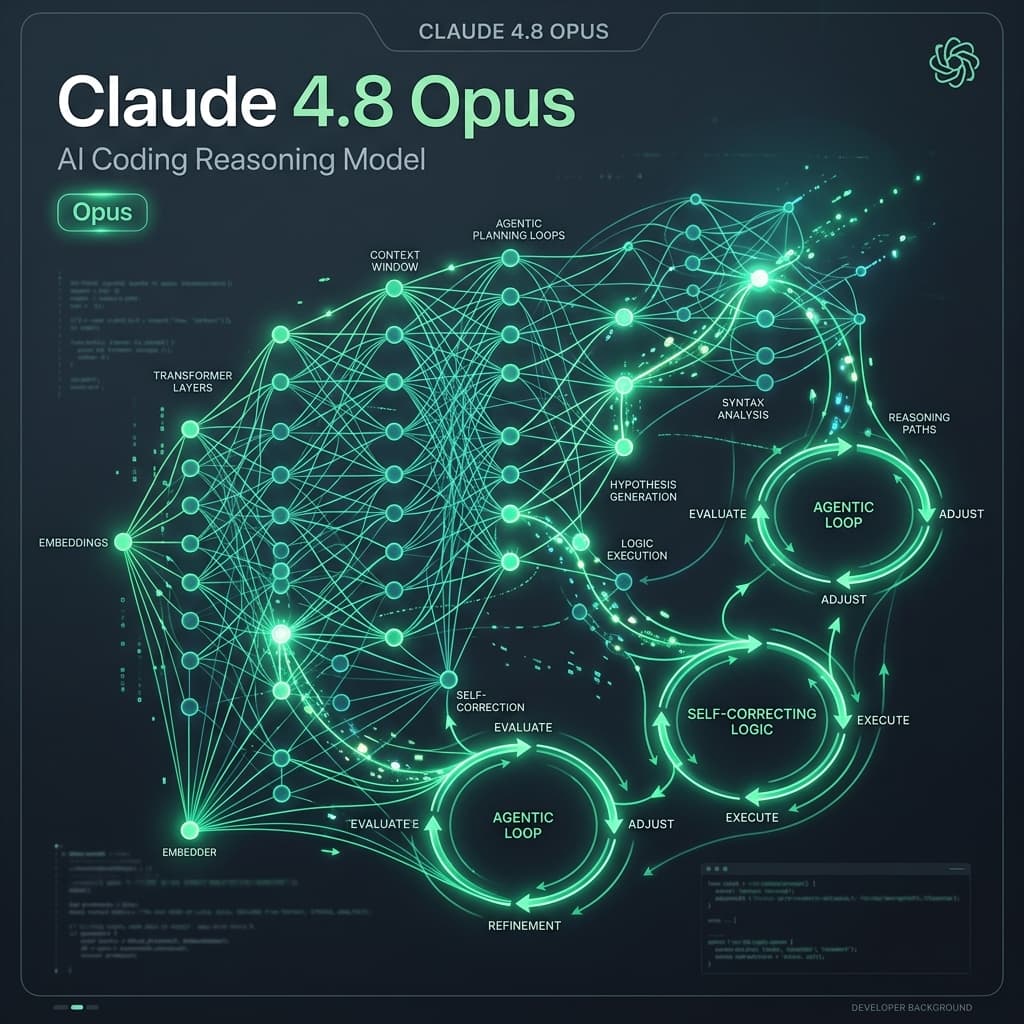
The Cognitive Leap: Claude 4.8 Opus
In the rapidly evolving landscape of generative artificial intelligence, Anthropic's release of Claude 4.8 Opus marks a significant architectural milestone. Moving beyond passive text-based transformers, Opus 4.8 represents a new class of cognitive reasoning models designed to tackle highly complex multi-turn logic, advanced mathematical proofs, and industrial-scale software synthesis. For developers and engineering teams, this release represents a massive productivity upgrade—shifting the AI paradigm from simple helper autocompletion to true asymmetric pair programming.
Key Benchmark Achievements
Opus 4.8 establishes new state-of-the-art parameters across core reasoning benchmarks, particularly in code synthesis and mathematical execution:
| Benchmark Category | Opus 4.8 Score | Previous Standard (Opus 4.7) | Key Focus Area |
|---|---|---|---|
| HumanEval (Coding) | 96.8% | 92.0% | Multi-language logic synthesis |
| SWE-bench (Software Engineering) | 44.5% | 33.0% | Resolving GitHub bugs in codebases |
| MATH (Competition Level) | 89.2% | 71.1% | Asymmetrical logic & proofs |
| GPQA (Graduate Level Q&A) | 68.4% | 59.4% | Ph.D. level scientific reasoning |
Agentic Tool-Use and WebAssembly Sandboxes
What makes Claude 4.8 Opus a major advancement is its optimized Agentic Planning Loop. Rather than outputting code blindly, the model is architected to perform multi-step planning. It formulates a hypothesis, writes code, tests it inside a local, browser-safe WebAssembly sandboxed runtime, analyzes console error logs, and automatically refactors its own output before presenting the final result.
This self-correcting cycle dramatically reduces syntactic mistakes, ensuring that compiled blocks—whether they are React hooks or cryptographic algorithms like asymmetric key generators—operate correctly out of the box.
How Engineering Teams Capitalize
The arrival of reasoning engines like Claude 4.8 Opus alters the required engineering skill set. Syntactic code writing is no longer the bottleneck. Instead, the premium shifts to system design, security analysis, and input sanitization.
For instance, while a reasoning model can write an interactive query tool instantly, the engineer must guide the model to secure it against injection parameters—such as implementing robust SQL injection escaping structures or using prepared statement parameterization blocks.
Try it free