
The Claude Fable 5 Takedown: Why Anthropic Suspended its Mythos-Class Models
Just days after releasing its powerful Claude Fable 5 and Mythos 5 models, Anthropic has pulled them offline globally due to U.S. export directives. We examine the telemetry and compliance triggers behind the move.

The Claude Fable 5 Takedown: Why Anthropic Suspended its Mythos-Class Models
The global artificial intelligence landscape was sent into a tailspin on June 13, 2026. Anthropic issued a sudden, worldwide suspension of its recently launched Claude Fable 5 and Claude Mythos 5models. The models, which represented Anthropic's new frontier of "Mythos-class" cognitive reasoners, were pulled offline entirely in response to an urgent export control directive from the United States government.
A brief timeline of the release and retraction
The suspension caps a whirlwind week of events that highlights the friction between frontier AI capabilities and national security policy:
- June 9, 2026: Anthropic announces the release of Claude Fable 5 and its unrestricted sibling, Mythos 5. Fable 5 features strict built-in safety filters that reroute high-risk queries (e.g., in cyberwarfare or biology) to Claude Opus 4.8. Mythos 5 runs unrestricted, limited to select partners under "Project Glasswing."
- June 12, 2026: The U.S. government issues an emergency export control order, restricting high-horizon cognitive reasoning models from being accessed by users in specific regions or of certain national origins.
- June 13, 2026: Unable to immediately deploy a reliable, tamper-proof system to filter user access based on residency or nationality, Anthropic takes the drastic step of taking both models offline globally.
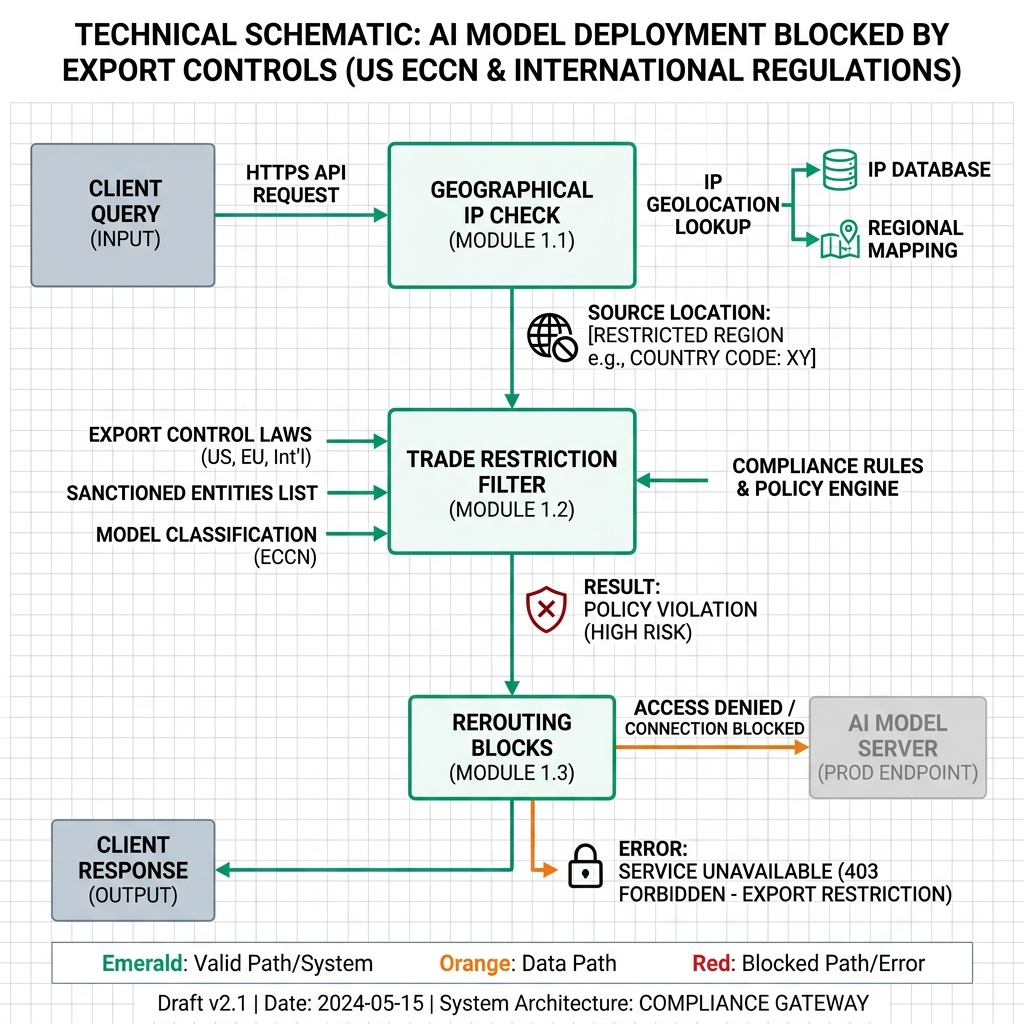
The technical challenge: Auditing user residency
The core hurdle for Anthropic lies in the limitations of standard web traffic telemetry. Geographical IP boundaries are easily bypassed via virtual private networks (VPNs) or proxy configurations, making standard location-based routing insufficient for federal compliance.
To comply with the new directives, Anthropic must build a multi-layered compliance validation pipeline:
- Telemetry Audits: Inspecting browser user agent headers, client timezones, language variables, and screen parameters to detect routing discrepancies.
- Cryptographic Authorization: Requiring client applications to submit signed authorization tokens that verify the verified physical location and identity of the entity invoking the API.
Conclusion
The suspension of Claude Fable 5 and Mythos 5 marks the first time a major AI lab has pulled a frontier model offline in response to export compliance rules. It signals a new era where web developer workflows and API distribution are governed not just by technical limits or safety filters, but by strict geopolitical borders and verified digital identity frameworks.
Try it free