
FD Interest Calculation Guide: Simple vs Quarterly Compounding
Fixed Deposits offer maximum capital safety. Learn how short-term simple interest and quarterly compounding works, and how to maximize cumulative maturity yields.
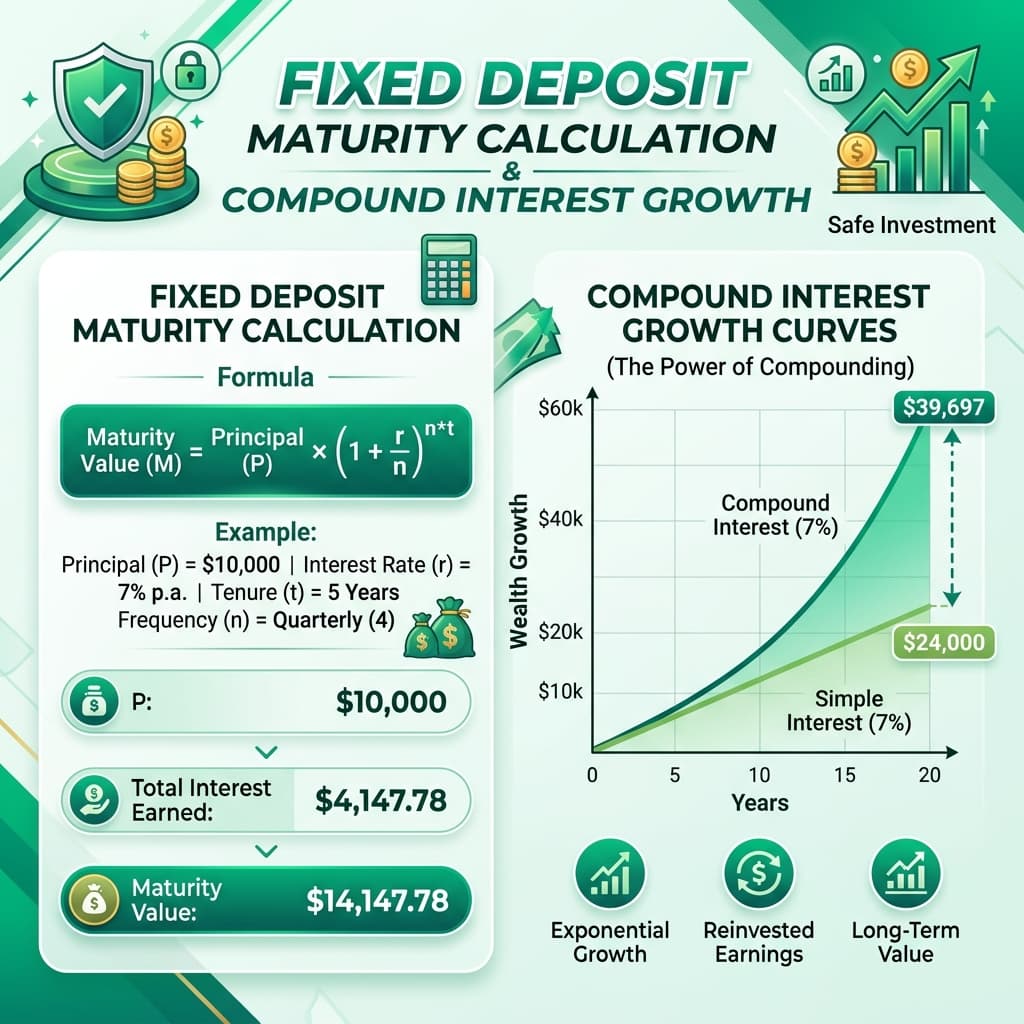
Fixed Deposits (FD): The bedrock of Indian Investments
Despite the rise of mutual funds and stock market investments, the **Fixed Deposit (FD)** remains a cornerstone of household savings in India. Backed by banks and guaranteed up to ₹5 Lakhs by the DICGC (a subsidiary of the RBI), FDs offer complete capital safety and predictable returns.
However, many investors don't realize that different banks compound interest differently, which affects the final maturity amount.
Let's look at how FD interest is calculated and how compounding intervals impact your savings.
How FD Interest is Calculated: Simple vs. Compound
Depending on the tenure of your deposit, banks use one of two interest calculation methods:
1. Simple Interest (Short-term FDs)
For FDs with a tenure of 6 months or less, banks apply simple interest. The formula is:
Simple Interest = (P × R × T) / 100

Where:
  P = Principal Amount
  R = Annual Interest Rate (%)
  T = Time period in years (e.g., 6 months = 0.5 years)
2. Compound Interest (Long-term FDs)
For FDs with a tenure exceeding 6 months, banks compound the interest. In India, most major banks (like SBI, HDFC, and ICICI) **compound interest quarterly** (4 times a year). The formula is:
A = P × (1 + R / (n × 100))^(n × T)

Where:
  A = Maturity Amount
  P = Principal Amount
  R = Annual Interest Rate (%)
  n = Number of compounding intervals per year (for quarterly, n = 4)
  T = Total tenure in years
Example: If you invest ₹1,00,000 for 5 years at a quarterly compounded rate of 7%:
A = 1,00,000 × (1 + 7 / (4 × 100))^(4 × 5)
  = 1,00,000 × (1 + 0.0175)^20
  = 1,00,000 × (1.0175)^20
  = ₹1,41,478
You earned a total interest of **₹41,478** over 5 years.
How to Maximize Your FD Returns
- Choose Reinvestment (Cumulative FD) — Instead of receiving monthly or quarterly payouts, choose the cumulative option. This keeps the interest inside the account, letting it compound quarterly.
- Use FD Ladders — Instead of locking up a large sum in a single 5-year FD, break it into five smaller FDs maturing in 1, 2, 3, 4, and 5 years. This ensures liquidity and lets you reinvest maturing funds at prevailing rates.
Calculate Your FD Maturity Instantly
Avoid doing complex exponential math by hand. Use our free FD Calculator. Simply enter your deposit amount, interest rate, and tenure, and it will calculate your total maturity value and show you the exact quarterly interest split instantly.
If you want to compare your FD returns with systematic equity investments, check out our SIP Calculatorto see how safe compounding stacks up against stock market averages.
Try it free