
Google Gemini Spark and Antigravity 2.0: Architecting Parallel Agent Orchestrations
Google has launched Gemini Spark alongside the Antigravity 2.0 orchestration platform. Discover how parallel sub-agents communicate and execute code blocks locally.
Google Gemini Spark & Antigravity 2.0: The Multi-Agent Horizon
In early June 2026, Google announced a massive expansion of its artificial intelligence lineup. By launching the Gemini Spark workspace suite alongside the Antigravity 2.0 parallel orchestration platform, Google has introduced a new capability: deploying specialized networks of sub-agents that collaborate in parallel to solve complex software engineering and data analytics tasks.
Antigravity 2.0: Architecting Parallel Agent Orchestration
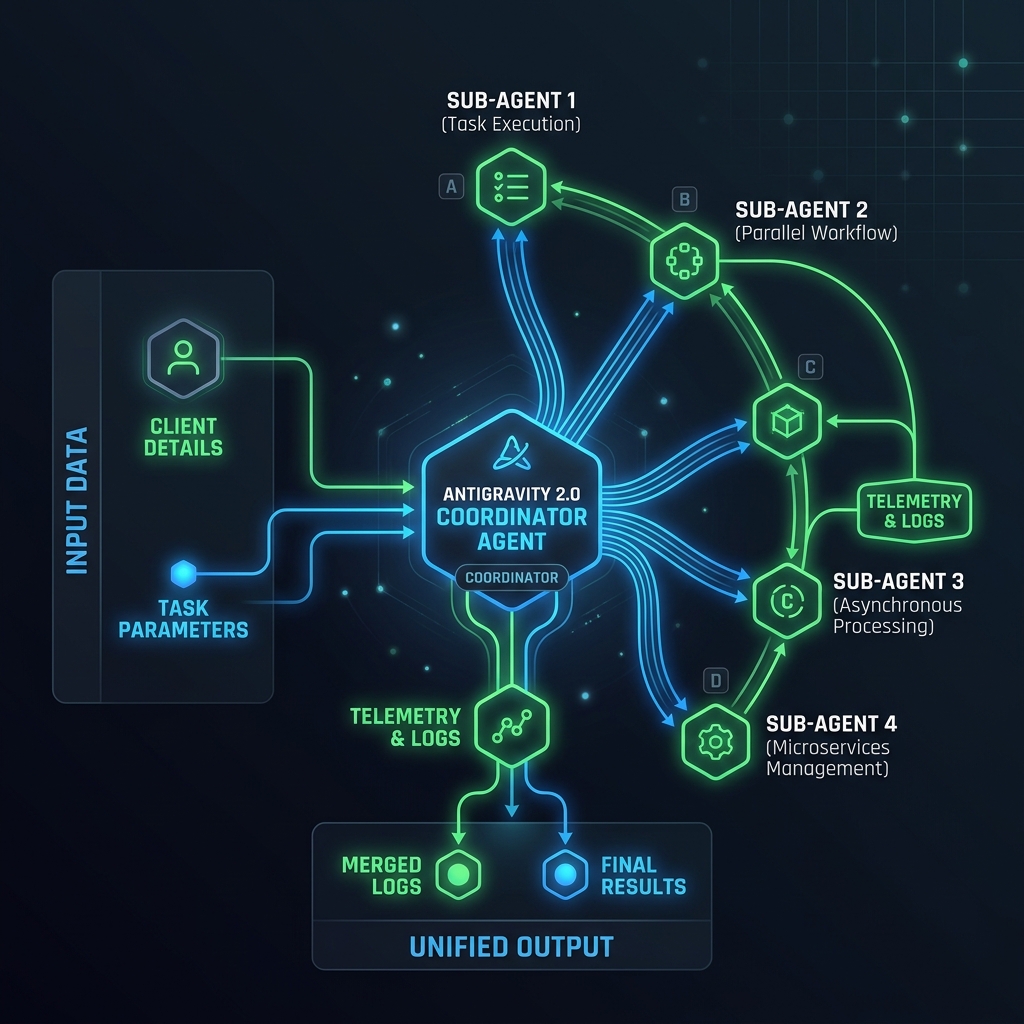
Antigravity 2.0 operates as an agent coordinator. Instead of relying on a single large language model to execute all phases of a project, the platform divides the task among dedicated sub-agents:
- Research Sub-Agents: Scan configurations, identify layout properties, and parse browser client headers.
- Developer Sub-Agents: Generate code snippets, build configuration tables, and convert YAML/JSON structures.
- Verifier Sub-Agents: Execute local runtime audits, verify cryptographic signatures, and check color accessibility contrast levels.
Ensuring Fast, Client-Side Communication
A key challenge in multi-agent orchestration is communication latency. If every sub-agent has to query remote APIs for simple operations, the entire network grinds to a halt. Antigravity 2.0 addresses this by executing utility tasks locally inside the browser. By running tools like local user-agent parsers and offline formatters on the client side, sub-agents can share data with near-zero latency.
Collaborative Telemetry Integration
To maintain coherence, the coordinator agent constantly monitors the execution telemetry of its sub-agents. It collects and merges local screen properties, resolved timezones, and network speeds to optimize code output for the user's specific environment. This local context integration ensures that the compiled components align with design tokens and accessibility guidelines.
Conclusion
The launch of Gemini Spark and Antigravity 2.0 highlights that the next phase of software development lies in multi-agent collaboration. By partitioning complex goals into parallel streams and optimizing local browser-based execution, developers can build highly intelligent, privacy-compliant agentic platforms that scale with minimal server overhead.
Try it free