
Generative AI Trends in 2026: Agentic Workflows, SLMs, and Local Execution
Explore the massive paradigm shift of 2026: how AI is moving from passive prompt chat boxes to fully autonomous agentic networks and local Small Language Models (SLMs).
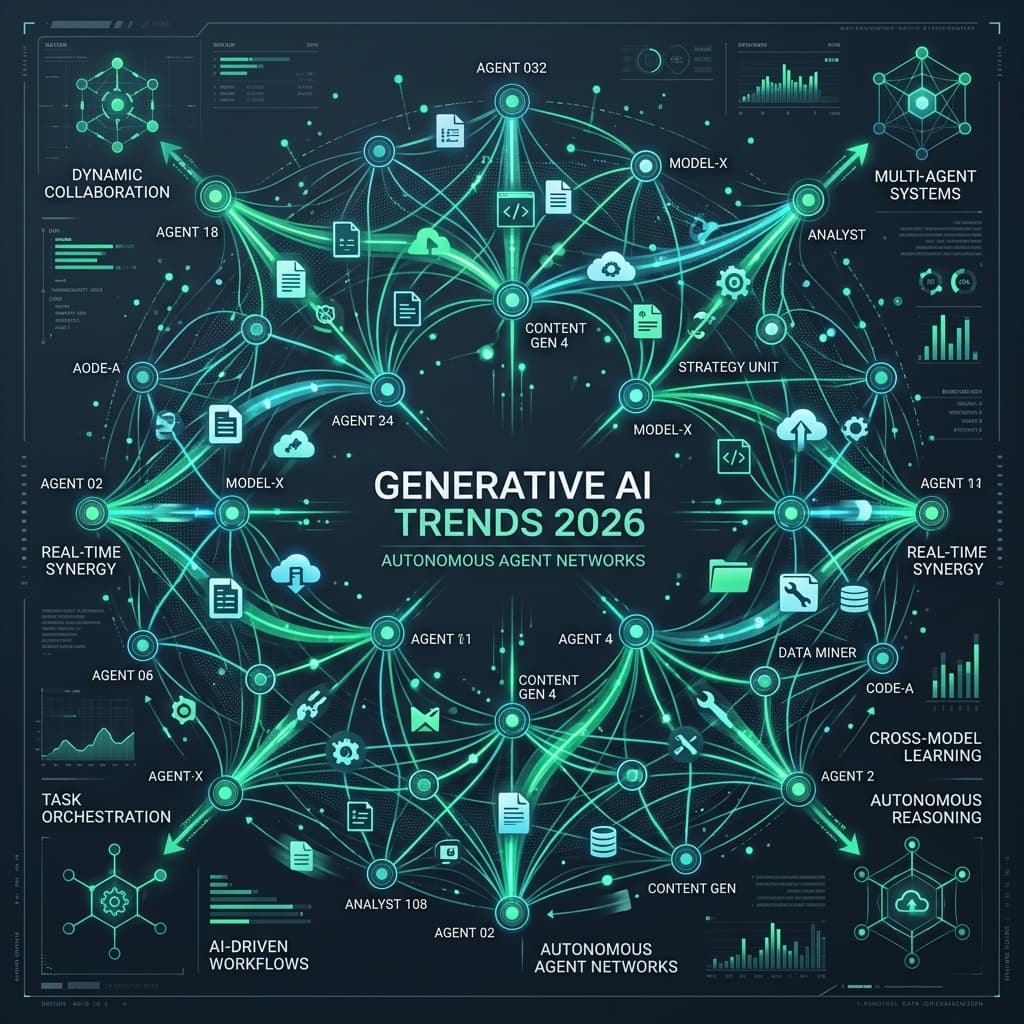
Generative AI in 2026: The Agentic Paradigm
For the first few years of the artificial intelligence boom, the primary interaction pattern was the simple conversational chat box. Users typed a prompt, and the LLM returned a static text block. However, the industry has undergone a massive paradigm shift. In 2026, generative AI is moving away from passive chatbots towards fully autonomous, multi-step agentic systems and lightweight on-device execution.
1. The Shift to Agentic Workflows
Instead of answering queries in a single shot, modern AI systems act as agents. Given a high-level goal, an agent can:
- Deconstruct a complex task into a sequence of smaller, logical sub-goals.
- Invoke external tools, browser APIs, or database search handlers to collect information.
- Validate the output, run unit tests, and self-correct when code errors or logic failures occur.
This allows AI to operate as proactive team members, executing long-running tasks autonomously and checking back only for high-level approvals or clarifications.
2. On-Device Small Language Models (SLMs)
While giant frontier models like Claude 4.8 Opus power complex cloud reasoning tasks, 2026 is experiencing an explosion of high-efficiency Small Language Models (SLMs) running entirely on-device. Models in the 1B to 3B parameter range (like Microsoft Phi-4 or Google Gemma 2) can now run locally in the browser utilizing standard web runtimes.
By running models locally via WebAssembly, applications can perform smart text corrections, syntax check loops, and semantic lookups with zero latency, zero cloud API costs, and absolute data privacy.
3. Tool-Use and Web Integration
Another major trend is the standardization of AI Tool-Use (Function Calling). Modern models are trained to output structured query commands (like JSON or parsed URL query arguments) instead of conversational prose. This allows models to seamlessly manipulate user interfaces:
- Dynamically building and modifying URL parameter query grids in real time.
- Calling cryptographic Subtle API tools to generate secure RSA or Elliptic Curve key pairs.
- Instantly converting CSV lists to ASCII markdown tables for developer documentations.