
CPI & Inflation: How to Calculate Historical Currency Purchasing Power
How has the purchasing power of your money changed since 1980? Learn the math of Consumer Price Index (CPI) adjustments, how to calculate historic rupee and dollar values, and why it matters.
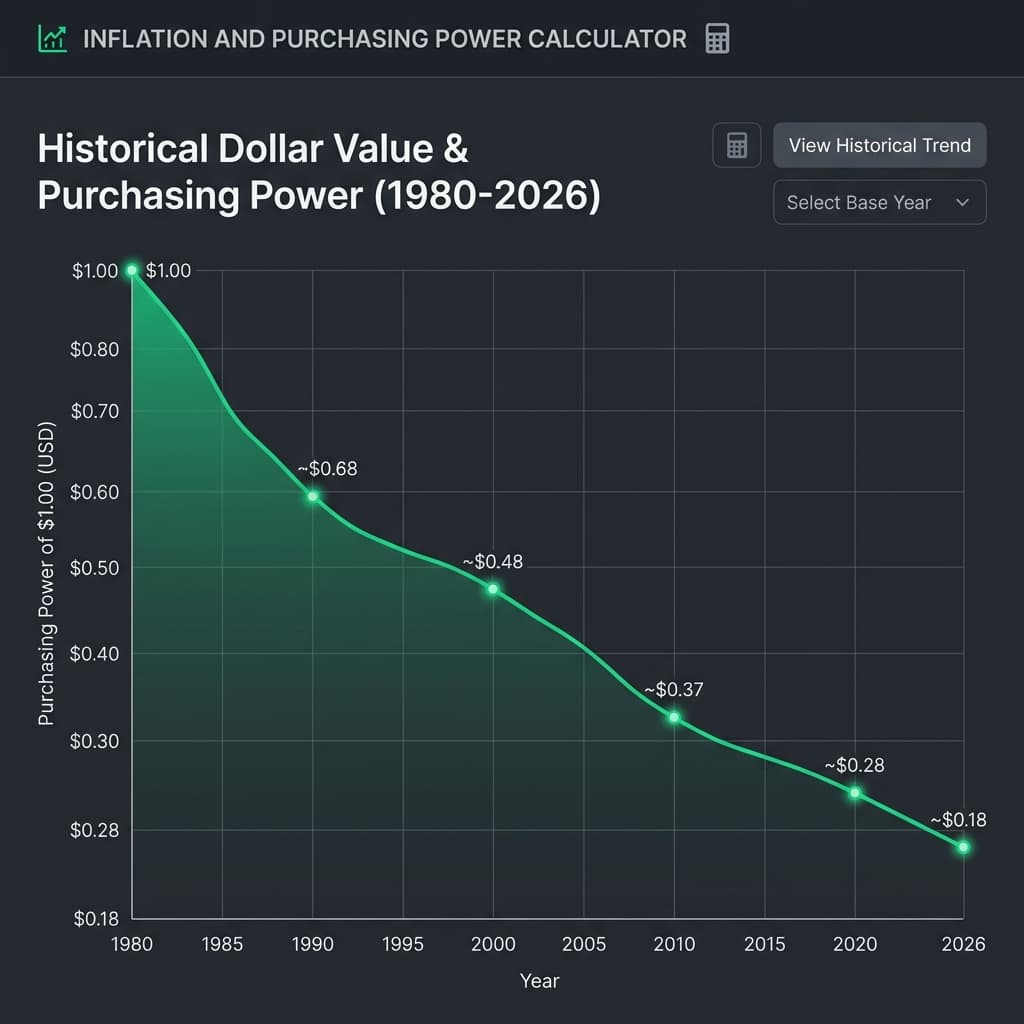
What is Inflation and Purchasing Power?
In economics, inflation is the gradual increase in the general price level of goods and services in an economy over time. As prices rise, each unit of currency buys a smaller percentage of a good or service. This represents a direct decline in **purchasing power**—the real value of money.
For instance, a single dollar in 1980 could buy a gallon of gasoline or three candy bars. Today, due to compounding inflation, that same dollar represents only a fraction of those items. Understanding inflation is critical for long-term financial planning, setting realistic savings targets, and matching investment yields.
How is Inflation measured? The Consumer Price Index (CPI)
Governments track inflation using a metric called the Consumer Price Index (CPI). Calculated monthly by national agencies (like the Bureau of Labor Statistics in the US or MOSPI in India), CPI measures the average change over time in the prices paid by urban consumers for a market basket of consumer goods and services (including food, housing, transport, medical care, and energy).
By establishing a reference base year (where CPI equals 100), economists can compare index levels across decades to calculate precise price inflation.
The Conversion Formula: How to Adjust Values
To compare the value of money in a **Start Year** to its purchasing power equivalent in a **Target Year**, use this simple formula:
Equivalent Value = Amount × (CPI in Target Year ÷ CPI in Start Year)Step-by-Step Practical Example
Suppose you want to know what $1,000 in 1990 is worth in 2026.
- Look up the US CPI averages:
• US CPI in 1990 =130.7
• US CPI in 2026 =328.0 - Calculate the ratio:
Ratio = 328.0 ÷ 130.7 ≈ 2.5095 - Multiply by the starting amount:
Equivalent Value = $1,000 × 2.5095 = $2,509.56
This means that due to inflation, you need $2,509.56 in 2026 to buy the exact same basket of items that cost only $1,000 in 1990! The cumulative inflation rate is 150.95%.
Inflation in India vs. the United States
Developing economies (like India) typically experience higher average inflation rates than developed economies (like the US) because of rapid expansion, supply constraints, and currency adjustments:
- United States: Historically averages around 2% to 4% inflation annually over the last four decades.
- India: Averaged around 6% to 8% inflation annually over the same period, meaning Indian rupee prices double much faster than US dollar prices.
Calculate Historical Values Instantly
Skip the search for CPI tables! Use our free Historical Inflation Calculator. Select either the US Dollar or Indian Rupee, input your starting amount and year ranges, and get instant calculations showing equivalent target values, purchasing power decay, annualized rates, and interactive growth charts.