
OpenAI GPT-5.6 Preview: The Next Phase of Agentic System Design
OpenAI has released the developer preview of GPT-5.6, a model specifically optimized for autonomous agentic workflows, complex tool loops, and local logic validation.
OpenAI GPT-5.6: The Shift to Autonomous Agent Loops
With OpenAI's developer preview launch of GPT-5.6, the artificial intelligence landscape has reached a new architectural consensus. The era of conversational, prompt-and-response chatbots is giving way to fully autonomous agentic frameworks. GPT-5.6 is designed from the ground up to operate within multi-step task loops, invoking tools, checking outputs, and self-correcting logic client-side.
Optimized Multi-Step Function Calling
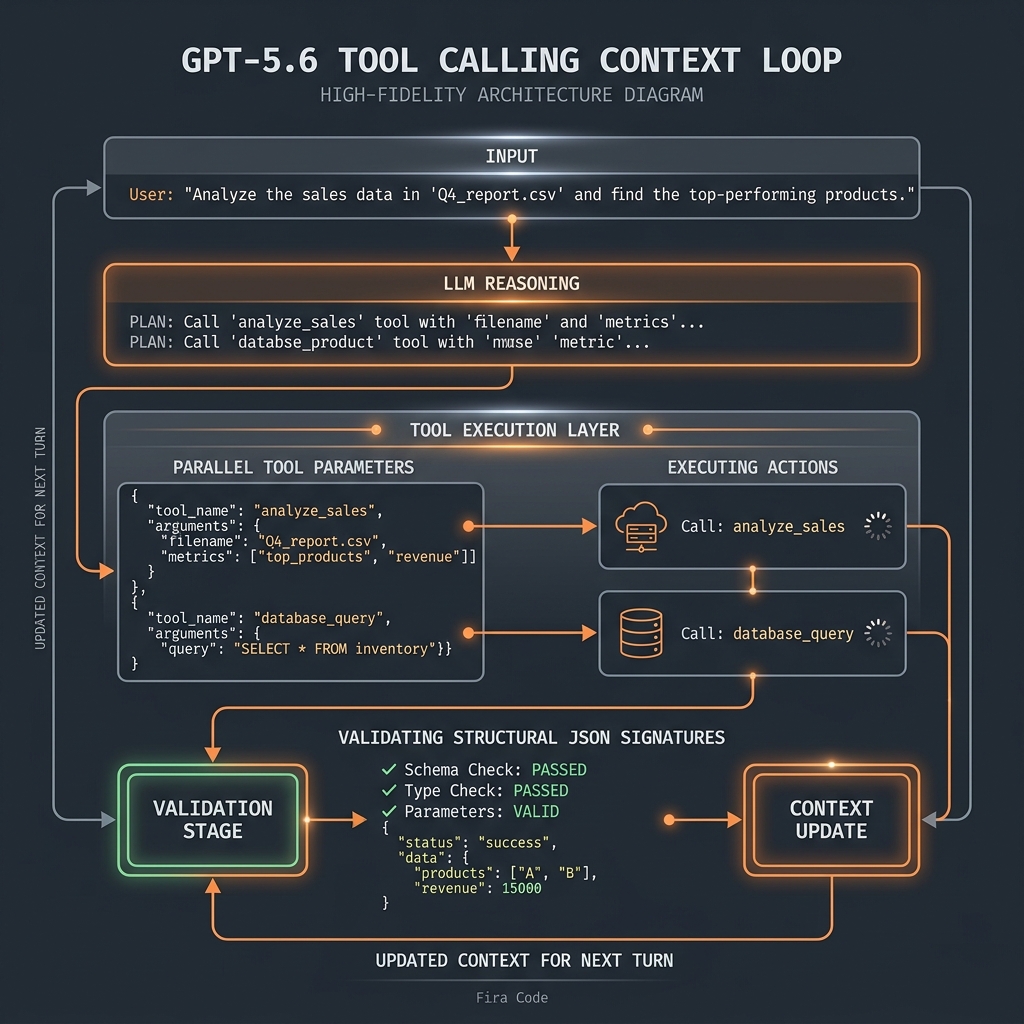
The core upgrade in GPT-5.6 lies in its tool orchestration and parameter mapping precision. In previous generations, models frequently suffered from dropped parameters or syntax errors when attempting to execute complex API configurations. GPT-5.6 addresses this with a dedicated hardware-level attention mechanism that validates JSON structures before returning them. Key advantages for developers include:
- Structural Validation: High reliability in compiling complex configuration schemas, such as converting nested YAML manifests into validated JSON objects.
- Parallel Call Execution: The ability to trigger multiple API configurations simultaneously, allowing sub-agents to check security tokens and parse browser user agents concurrently.
- Local Verification: Seamless integration with local JavaScript runtimes, including verifying JWT headers and executing cryptographic signing loops completely offline.
Designing for Agentic Workflows
To capitalize on GPT-5.6, system designers must transition away from single-prompt chains. Instead, workspaces should be structured as agentic loop pipelines:
- Goal Deconstruction: The model maps out a multi-step execution plan based on the user's initial requirement.
- Local Tool Invocation: Sub-agents execute local code validators, format tables, or calculate interest projections.
- Console-safe Auditing: The model evaluates the execution results inside a secure client sandbox, automatically resolving bugs without user intervention.
Conclusion
The GPT-5.6 developer preview emphasizes that raw intelligence is no longer the sole goal. The premium has shifted to tool reliability and structured execution. Developers who design systems around autonomous loops, client-side verification, and strict input-escaped query parameters will build the most robust platforms in the agentic era.
Try it free