
Quantum-Resilient Security in 2026: Preparing for Post-Quantum Cryptography
Quantum computers pose an existential threat to current encryption methods. Learn about the post-quantum standards of 2026, photonic key distribution systems, and how to audit your software assets.
Quantum-Resilient Security: Preparing for Post-Quantum Cryptography
The threat of quantum computing to modern encryption has transitioned from theoretical research to an active timeline. With the rapid progress of quantum hardware, standard public-key cryptography—which secures everything from HTTPS connections to financial transactions—is vulnerable. As a result, software developers and security engineers must prepare for the transition to Post-Quantum Cryptography (PQC).
The vulnerability of classical keys
Most modern web security relies on prime factorization (RSA) or discrete logarithms (Diffie-Hellman, Elliptic Curve Cryptography) to secure communication channels. While these mathematical problems are virtually impossible for classical computers to solve in a reasonable timeframe:
- Shor's Algorithm: A sufficiently large quantum computer running Shor's algorithm can solve prime factorizations and discrete logarithms in polynomial time.
- Existential Threat: This allows an attacker to decrypt historical traffic that was captured and stored (the "Store Now, Decrypt Later" threat) or forge active session signatures.
The post-quantum landscape in 2026
The global transition to quantum-safe standards is gaining momentum. The National Institute of Standards and Technology (NIST) has finalized its first set of PQC algorithms, including ML-KEM (for key encapsulation) and ML-DSA (for digital signatures).
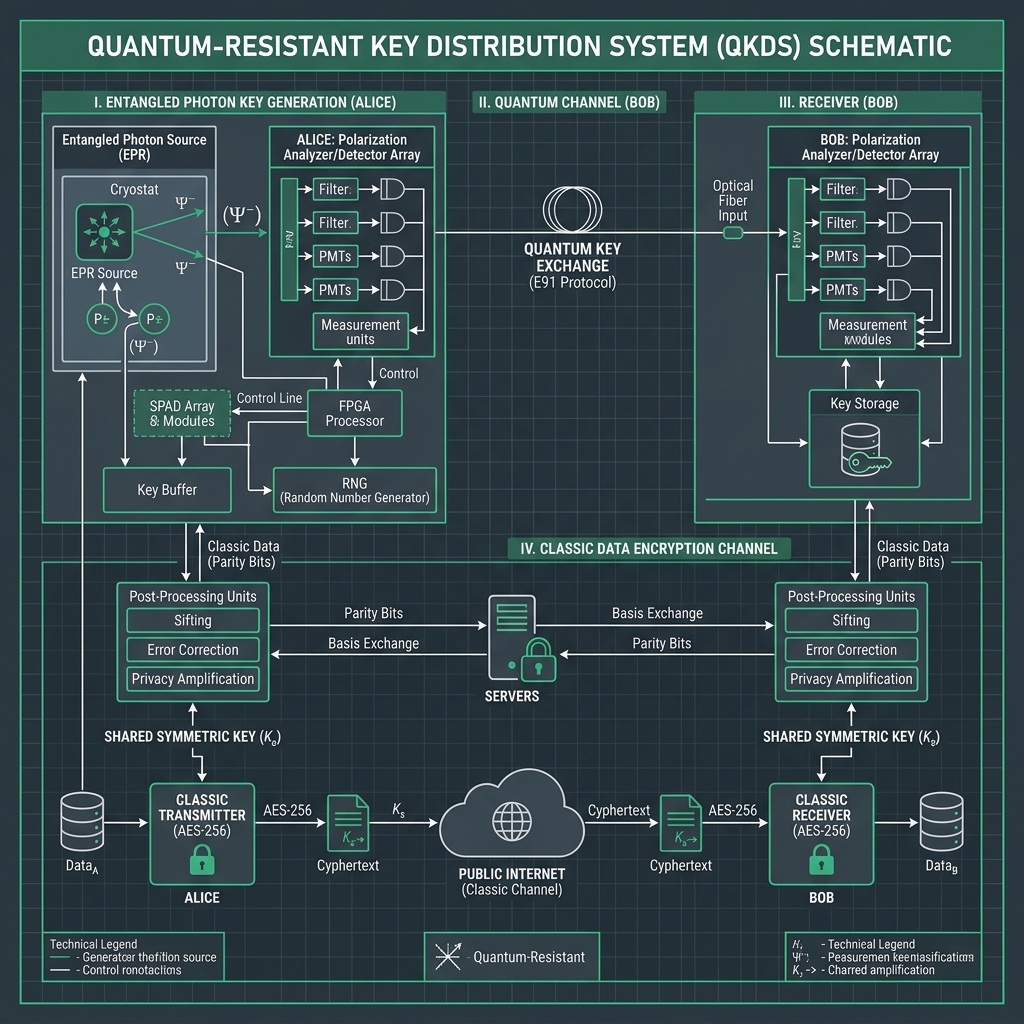
Concurrently, hardware startups are tackling the problem from the physical layer. For example, Bengaluru-based Pramatra Space recently demonstrated a photonics chip utilizing quantum entanglement to distribute secure, quantum-resilient encryption keys. This hybrid classic-quantum approach is designed to secure high-value communication nodes.
How developers should prepare
While standard PQC libraries are being integrated into major platforms and operating systems, application developers must audit their own codebases:
- Cryptographic Inventory: Identify where your applications generate, verify, or store public-private keys and JWT signatures.
- Hybrid Wrappers: Transition legacy protocols to hybrid setups that combine classical algorithms (like RSA or ECDSA) with quantum-safe variants (like ML-DSA) to maintain compliance while testing new architectures.
- Key Rotation: Build rotation-ready key architectures so that old key pairs can be deprecated and rotated without service interruptions.
Conclusion
Migrating the global web to post-quantum standards is a massive coordination challenge. By understanding relative luminance math for accessibility, CAGR returns for assets, and quantum-safe key profiles for cryptography, developers can build robust, future-proof platforms that protect data integrity in the decades to come.
Try it free