
How Readability Scores (Flesch-Kincaid) Direct Your SEO Rankings
User engagement dictates rankings. Learn how readability formulas work, how Flesch Reading Ease scores map to difficulty levels, and how to improve content accessibility.
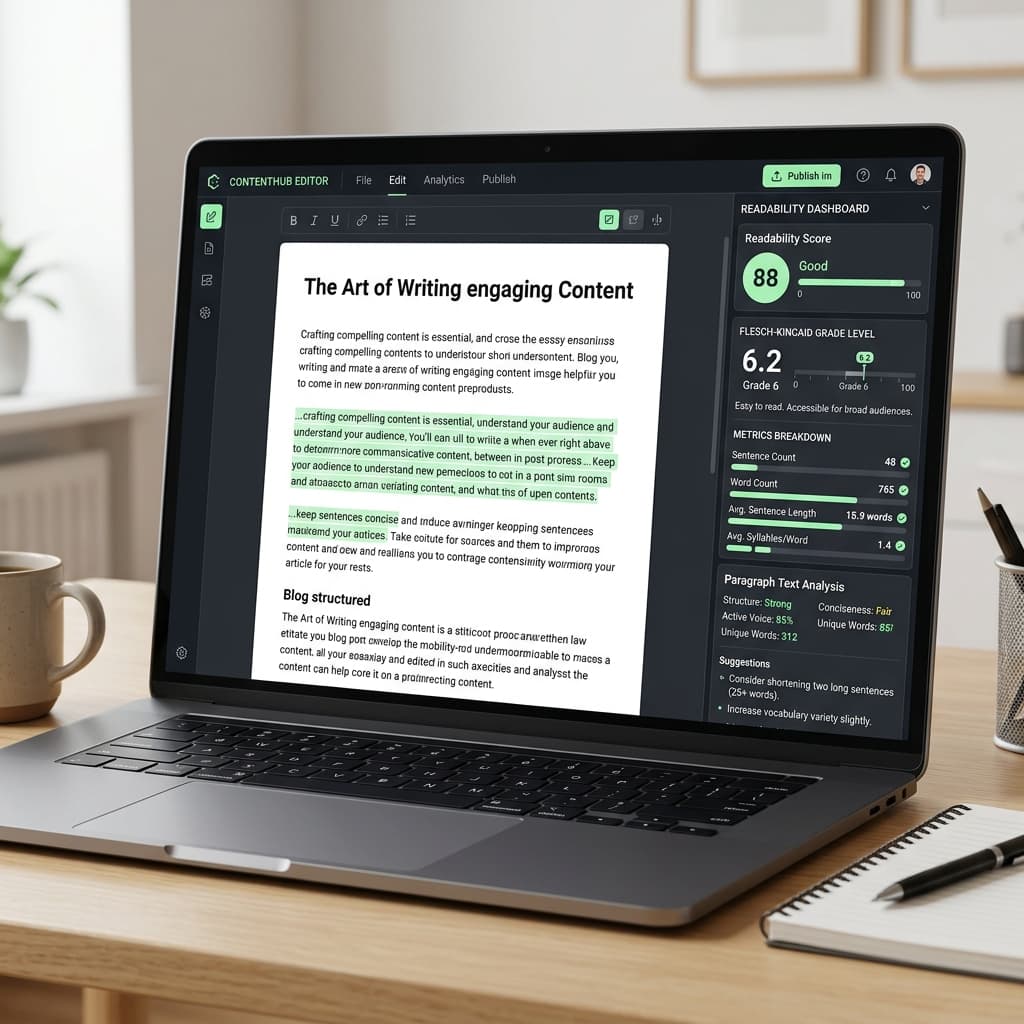
What is Readability, and Why Does It Matter?
Readability measures how easy a piece of written text is to read and comprehend. If your content is too dense, filled with complex jargon, or structured with long sentences, users will quickly leave your website.
Google's algorithms track user engagement signals like bounce rate and dwell time. If visitors bounce from your page because it's hard to read, your search rankings will suffer.
Understanding and optimizing your **readability score** is a highly effective way to improve user experience and elevate your search rankings.
The Math Behind Readability: Flesch-Kincaid
The most widely accepted standard for measuring text difficulty is the Flesch-Kincaid Reading Ease formula. It scores text on a scale from 1 to 100 based on sentence length and syllable count:
Score = 206.835 - (1.015 × ASL) - (84.6 × ASW)

Where:
  ASL = Average Sentence Length (number of words divided by number of sentences)
  ASW = Average Syllables per Word (number of syllables divided by number of words)
Interpreting the Flesch Reading Ease Scale
| Score Range | Reading Difficulty | Estimated School Grade |
|---|---|---|
| 90 – 100 | Very Easy | 5th Grade (10-11 years old) |
| 80 – 90 | Easy | 6th Grade |
| 70 – 80 | Fairly Easy | 7th Grade |
| 60 – 70 | Standard / Conversational | 8th – 9th Grade (13-15 years old) |
| 50 – 60 | Fairly Difficult | 10th – 12th Grade |
| 30 – 50 | Difficult | College student |
| 0 – 30 | Very Confusing / Academic | College graduate |
For standard web copy, blog posts, and marketing materials, your target score should be between 60 and 70. This ensures the text is accessible to the average reader.
How to Improve Your Readability Scores
- Shorten sentences — Break complex compound sentences into two simple sentences. Aim for an average of 15 words per sentence.
- Use active voice — Passive voice increases syllable counts and sentence length. Instead of "The report was written by Alex," write "Alex wrote the report."
- Avoid jargon — Replace complex words with simpler alternatives (e.g., replace "utilize" with "use").
Analyze Your Content Now
Before you hit publish, run your copy through our free online Readability Score Calculator. It parses your text instantly, calculates your Flesch-Kincaid Reading Ease, and gives you actionable feedback on sentence and syllable structures.
To track your overall content metrics, use our companion Word Counterto monitor your total length, paragraph counts, and keyword density.
Try it free