
Roman Numerals Explained: Conversion Rules and Mathematical Limits
Ancient Roman numbers are still everywhere, but how do they actually work? Learn the additive and subtractive rules of Roman numerals, and why standard systems lack zero or decimals.
The Legacy of Roman Numerals
Developed in ancient Rome, Roman numerals served as the primary counting and monetary numbering system in Europe for over a thousand years. While eventually replaced by the Arabic decimal system (0-9) because of easier columnar arithmetic, Roman numerals are still used today. They denote copyright dates on television programs, mark Super Bowl titles, label clock faces, designate monarchs (e.g., Queen Elizabeth II), and structure outline items in legal filings.
The Seven Basic Roman Symbols
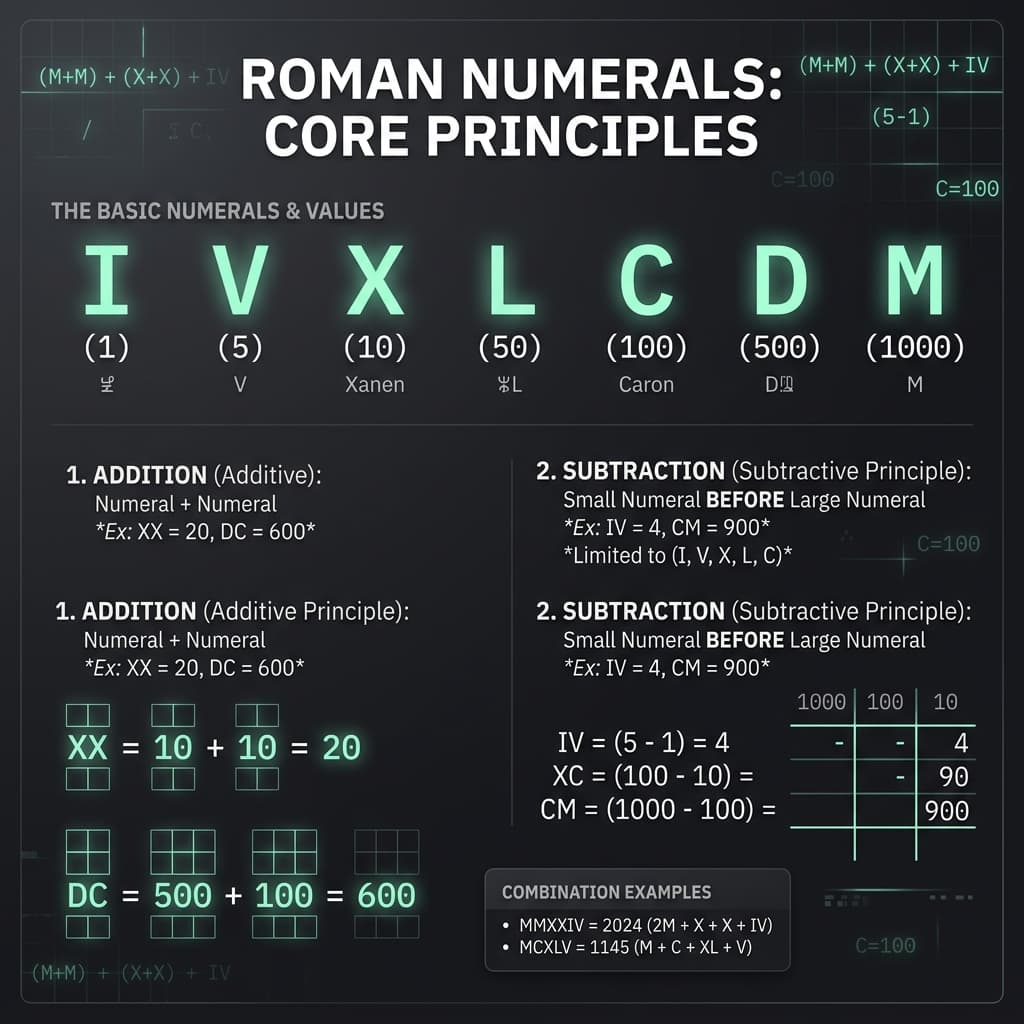
The Roman numeral system is non-positional and relies on seven letters from the Latin alphabet:
| Symbol | Value (Arabic Decimal) | Mnemonic helper |
|---|---|---|
| I | 1 | A single finger (digit) |
| V | 5 | A hand shape (angle between thumb and fingers) |
| X | 10 | Two crossed hands |
| L | 50 | Historic half-hundred mark |
| C | 100 | Centum (Latin for hundred) |
| D | 500 | Half of Mille (curved symbol split) |
| M | 1000 | Mille (Latin for thousand) |
The Subtractive and Additive Rules
Roman numerals are written left-to-right from largest to smallest. However, two rules govern their sequence layout:
- The Additive Rule: If a smaller symbol comes after a larger symbol, they are added.
VI ➔ 5 + 1 = 6CLX ➔ 100 + 50 + 10 = 160 - The Subtractive Rule: If a smaller symbol comes *before* a larger symbol, the smaller value is subtracted from the larger one. This was introduced to prevent having four identical characters in a row (e.g. avoiding
IIIIorXXXX):IV ➔ 5 - 1 = 4(instead of IIII)IX ➔ 10 - 1 = 9(instead of VIIII)XC ➔ 100 - 10 = 90(instead of LXXXX)CM ➔ 1000 - 100 = 900(instead of DCCCC)
Step-by-Step Conversion Example
Let's decode the complex numeral MCMXCIV:
- First symbol:
M = 1000. - Next pair:
CM. Because C (100) is before M (1000), it subtracts:1000 - 100 = 900. - Next pair:
XC. Because X (10) is before C (100), it subtracts:100 - 10 = 90. - Last pair:
IV. Because I (1) is before V (5), it subtracts:5 - 1 = 4. - Final Sum:
1000 + 900 + 90 + 4 = 1994.
Standard Limits: Why up to 3999?
Standard Roman numerals can only represent integers up to 3999 (MMMCMXCIX). To write 4000, you would need four Ms, which breaks the repetition limit rule. Ancient Romans solved this using overlines (vinculum) to multiply values by 1000, but modern tools generally adhere to the standard 1–3999 range.
Solve Roman Numeral Equations Instantly
Skip the manual mapping! Use our free Roman Numerals Converter. Convert any Arabic number to Roman numerals, decode Roman numerals to integers with visual logic logs, and perform full roman arithmetic calculations (e.g. adding, subtracting, multiplying, and dividing terms) with clean, educational math layouts.