
Securing REST APIs in 2026: Asymmetric RSA Key Pairs vs Symmetric HMAC Signatures
API security requirements are shifting rapidly. Compare the technical tradeoffs, signature verification speed, and implementation steps of symmetric HMAC secrets and asymmetric RSA key pairs in 2026.

Securing REST APIs: Asymmetric RSA Key Pairs vs Symmetric HMAC Signatures
In the API ecosystem, message integrity and client authentication remain the pillars of secure communications. As distributed multi-agent microservices and edge computing define the web landscape, developers must choose between two main signing paradigms: symmetric HMAC signatures and asymmetric RSA/ECDSA key pairs. Choosing the wrong method can expose secure environments to compromise or introduce unwanted latency overhead.
Symmetric signing: The HMAC approach
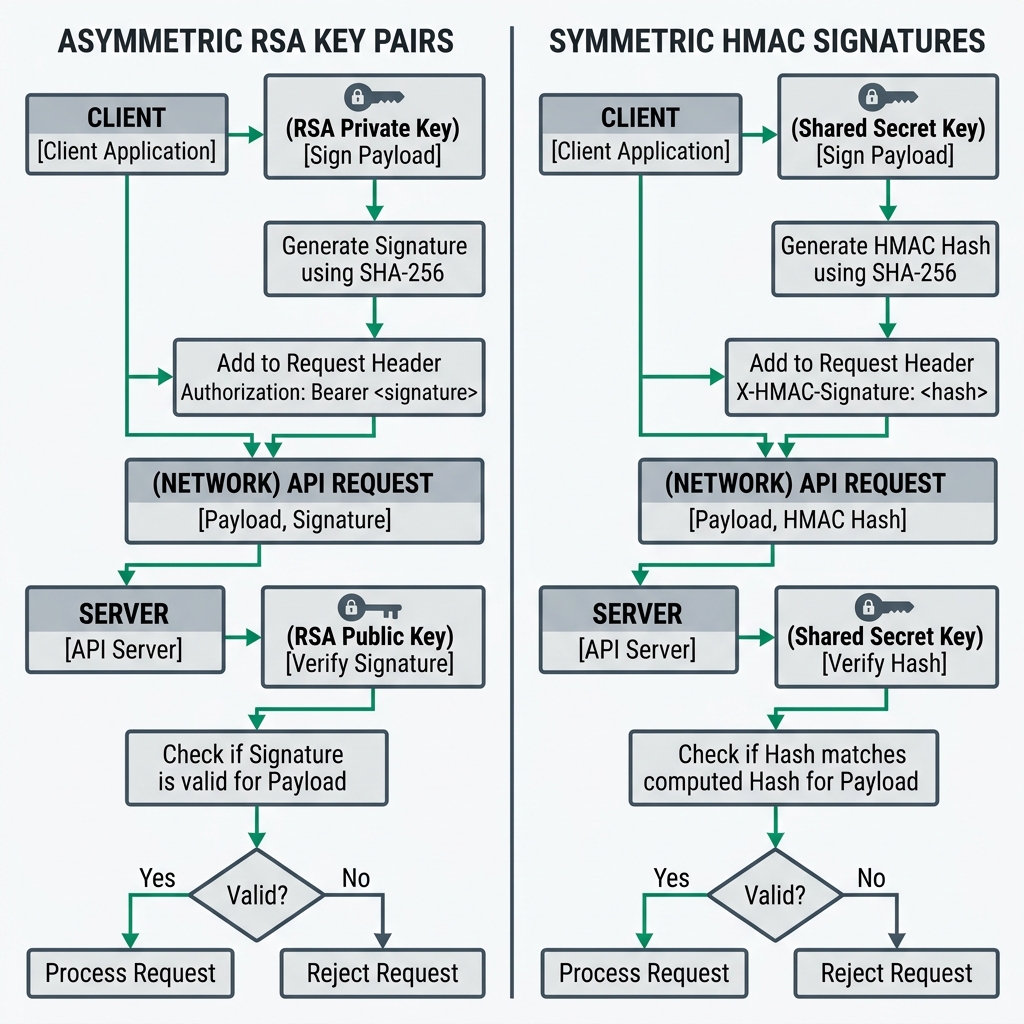
HMAC (Hash-based Message Authentication Code) utilizes a single shared secret key that both the sender and the receiver must possess. The message and the key are hashed together (commonly using SHA-256 or SHA-512) to produce a unique signature block.
- High performance: HMAC calculations are extremely fast, requiring minimal CPU cycles. This makes them perfect for high-throughput internal microservice networks.
- Key distribution risk: Since the same key is used for both signing and verification, every node that verifies the signature must know the secret. If one database node is compromised, the entire security perimeter is broken.
- No non-repudiation: Because both parties possess the same key, either party can create a valid signature. This prevents proof of origin in open API integrations.
Asymmetric signing: The RSA/ECDSA approach
Asymmetric cryptography splits the key into two distinct pieces: a private key (kept secret by the sender) and a public key (distributed openly). The sender encrypts a hash of the message using their private key, and the receiver verifies the signature using the corresponding public key.
- Perfect compartmentalization: The private key never leaves the origin server. Verifiers only need the public key, meaning a compromise of a client application does not allow them to forge signatures.
- Cryptographic non-repudiation: Only the holder of the private key could have created the signature, providing strong verification of identity.
- Computational cost: Asymmetric operations are significantly slower than symmetric hashing. Using RSA key pairs of 2048 or 4096 bits adds CPU overhead, though modern systems frequently combine this with JWT payloads to cache validation states.
Conclusion
For internal backend networks where endpoints are fully trusted, HMAC remains the industry standard due to its speed. However, for public APIs, decentralized authentication, and third-party integrations, asymmetric RSA/ECDSA is essential to maintain data boundaries and prevent secret sharing.
Try it free