
UUID vs GUID: What is the Difference?
Are UUIDs and GUIDs the same? Learn the subtle technical differences, the 128-bit structure details, and how to choose the right identifier version for database design.
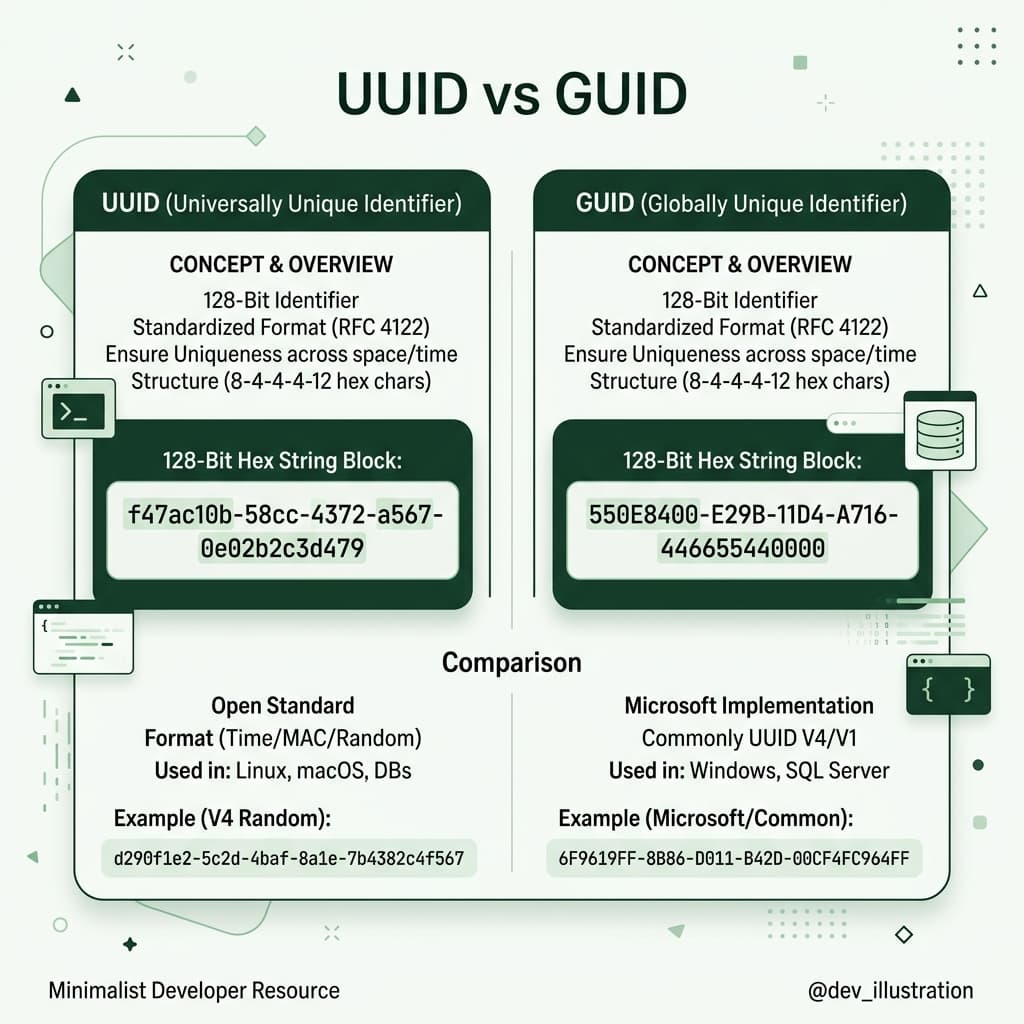
UUID and GUID: Are They the Same?
If you're designing a database, building an API, or setting up a distributed system, you need unique identifiers. You've probably heard the terms UUID (Universally Unique Identifier) and GUID (Globally Unique Identifier) used interchangeably.
Are they actually the same thing, or are there technical differences? Here is a quick, cut-to-the-point guide.
The Short Answer
Yes, they are practically the same.
A GUID is Microsoft's implementation of the UUID standard.
Think of it like this: UUID is the open standard (defined by RFC 4122), and GUID is Microsoft's brand name for it. Every GUID is a UUID, but not every UUID is a GUID (though in 99% of development contexts, they refer to the exact same 128-bit structure).
The Structure of a 128-bit Identifier
Both UUIDs and GUIDs are represented as a 32-character hexadecimal string split into five groups by hyphens:
123e4567-e89b-12d3-a456-426614174000This represents a 128-bit number. The format is always 8-4-4-4-12 characters.
Because it is 128 bits, the total number of possible UUIDs is 2128 (or 3.4 x 1038). To put that in perspective, if you generated 1 billion UUIDs every second for 100 years, the probability of creating a duplicate is virtually zero.
Versions of UUIDs: Which Should You Use?
The UUID standard defines different versions based on how the bytes are generated:
- UUID v1 (Time-based)— Generated using the host computer's MAC address and the current time. This guarantees order but exposes your machine's hardware address, posing a security risk.
- UUID v4 (Random)— Generated using cryptographically strong random numbers. This is the version most commonly used today because it doesn't leak system metadata.
- UUID v5 (Name-based SHA-1) — Generated by hashing a namespace identifier and a text string. The same input always produces the same UUID.
Generate Your Identifiers Instantly
Need to generate secure v4 UUIDs for your system configuration or database mockups? Use our free UUID Generator. It supports single or bulk generation entirely client-side.
If you need to verify or generate checksums of strings or data blocks, you can also use our Hash Generatorto calculate MD5, SHA-1, and SHA-256 hashes instantly.
Try it free