
How to Calculate Take-Home Net Salary in India from CTC
Demystifying the Indian salary payslip. Learn the difference between CTC and gross salary, monthly EPF deductions, Professional Tax, standard deductions, and TDS estimations.
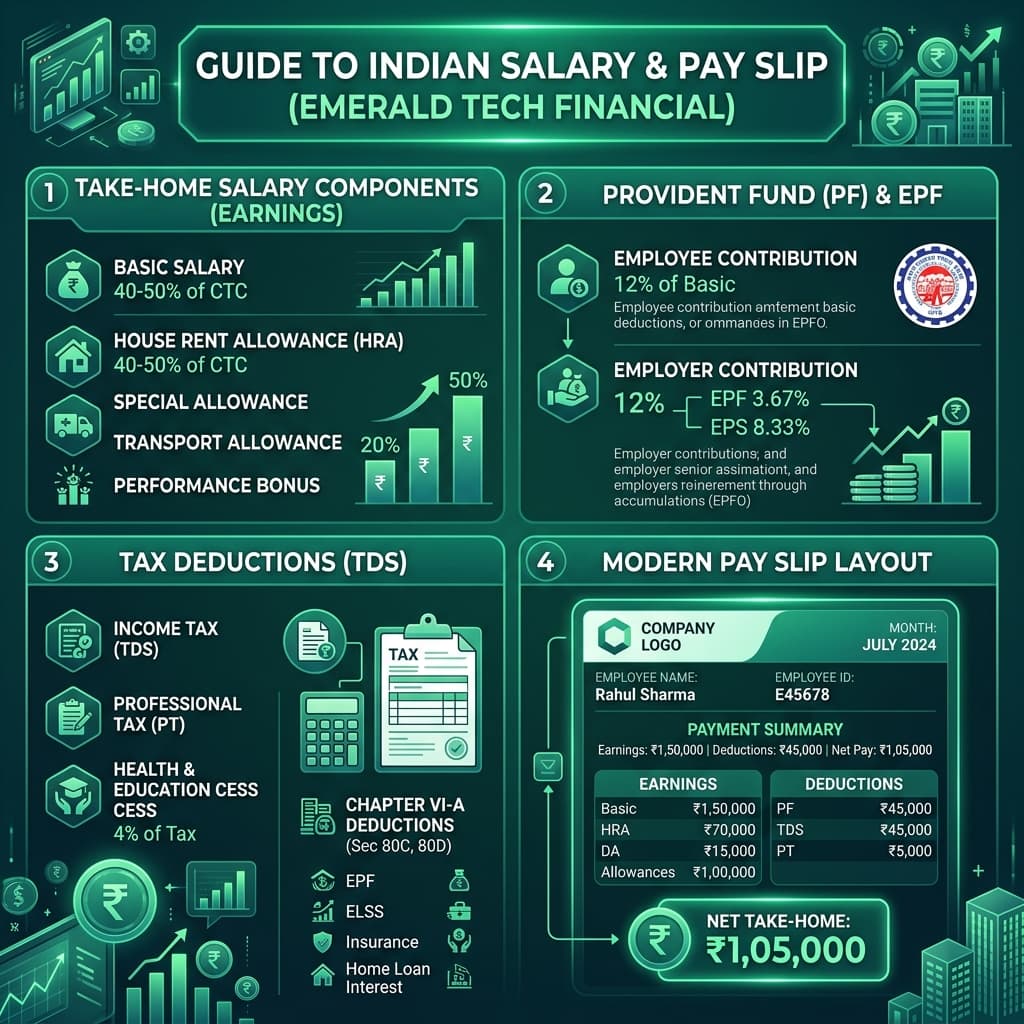
Gross vs. Net Salary: The Indian Pay Slip Explained
Getting a job offer with a high CTC (Cost to Company) is exciting, but the amount that actually lands in your bank account at the end of the month is often lower than expected.
Indian salary structures are notoriously complex, packed with abbreviations like PF, HRA, PT, and TDS. Understanding the difference between Gross Salary, Net Take-Home Salary, and CTC is essential for managing your personal finances and negotiating salary packages.
Let's break down the calculations step-by-step to see exactly how your monthly net take-home salary is computed.
Deconstructing CTC: The Components
CTC is the total cost an employer incurs to hire you. It is a annual package consisting of multiple buckets:
- Direct Salary (Gross Income) — The base salary paid to you monthly before any deductions. This includes Basic Salary, House Rent Allowance (HRA), Special Allowance, and Conveyance.
- Indirect Benefits— Benefits you enjoy but don't receive as cash, such as interest-free loans, medical insurance premiums paid by the employer, or free meals.
- Retireals / Contributions— Money deposited on your behalf into long-term savings schemes, mainly your employer's contribution to the Employee Provident Fund (EPF) and Gratuity.
CTC = Gross Salary + Employer PF Contribution + Gratuity + Other Benefits.
How to Calculate Your Net Take-Home Salary
Your net monthly take-home salary is computed by starting with your Gross Salary and subtracting both statutory deductions and income tax (TDS):
Net Take-Home = Gross Salary - (Employee EPF + Professional Tax + Monthly Income Tax)1. Employee EPF Contribution
Under the EPF Act, 12% of your Basic Salary + Dearness Allowance is deducted monthly for your provident fund. Your employer matches this contribution. The 12% employee contribution is tax-deductible under Section 80C.
2. Professional Tax (PT)
This is a state-level tax levied on salaried employees, capped at a maximum of ₹2,500 per year (usually deducted as ₹200 per month, with ₹300 in February for states like Maharashtra and Karnataka).
3. Tax Deducted at Source (TDS)
Based on your total annual taxable income and whether you chose the Old or New Tax Regime, your employer calculates your annual tax liability, divides it by 12, and deducts it monthly as TDS.
A Sample Take-Home Calculation
Let's calculate the net take-home salary for an employee with a Gross Salary of ₹12,00,000 per annum (₹1,00,000 per month) under the New Tax Regime:
- Monthly Gross: ₹1,00,000
- Employee EPF Contribution (Assuming Basic is 50% of gross): ₹6,000
- Professional Tax: ₹200
- TDS (Monthly Tax): ₹0 (since gross is ₹12L, taxable is under ₹12L after standard deduction, qualifying for the 87A rebate)
- Net Take-Home: ₹1,00,000 - ₹6,200 = ₹93,800 per month
Estimate Your Monthly Pay Slip
Avoid guessing your final pay. Use our free Salary Calculator. Input your monthly or annual CTC, structure your basic pay, and estimate your monthly take-home salary, EPF, and tax deductions side-by-side.
To model your tax liability precisely under the latest slabs, check out our Income Tax Calculatorto ensure you optimize your deductions and regime selection.
Try it free